

Special
A recovering perfectionist responds to grief and an abandoned novel

But first, here’s what’s happening in the Hummingbird Sanctuary
Yesterday, on the new moon in Pisces, we had a beautiful gathering where we explored how letting go of striving can paradoxically lead to breakthroughs. I guided a visualization with the help of some live music and we experienced some deep, embodied shifts toward more effortlessness.
In the chat, we’re supporting each other to continue with our ‘turtle steps’ of surrender, helping us achieve and serve with greater ease.
If you know you’re a hummingbird at heart, subscribe and join us next time in our safe space.
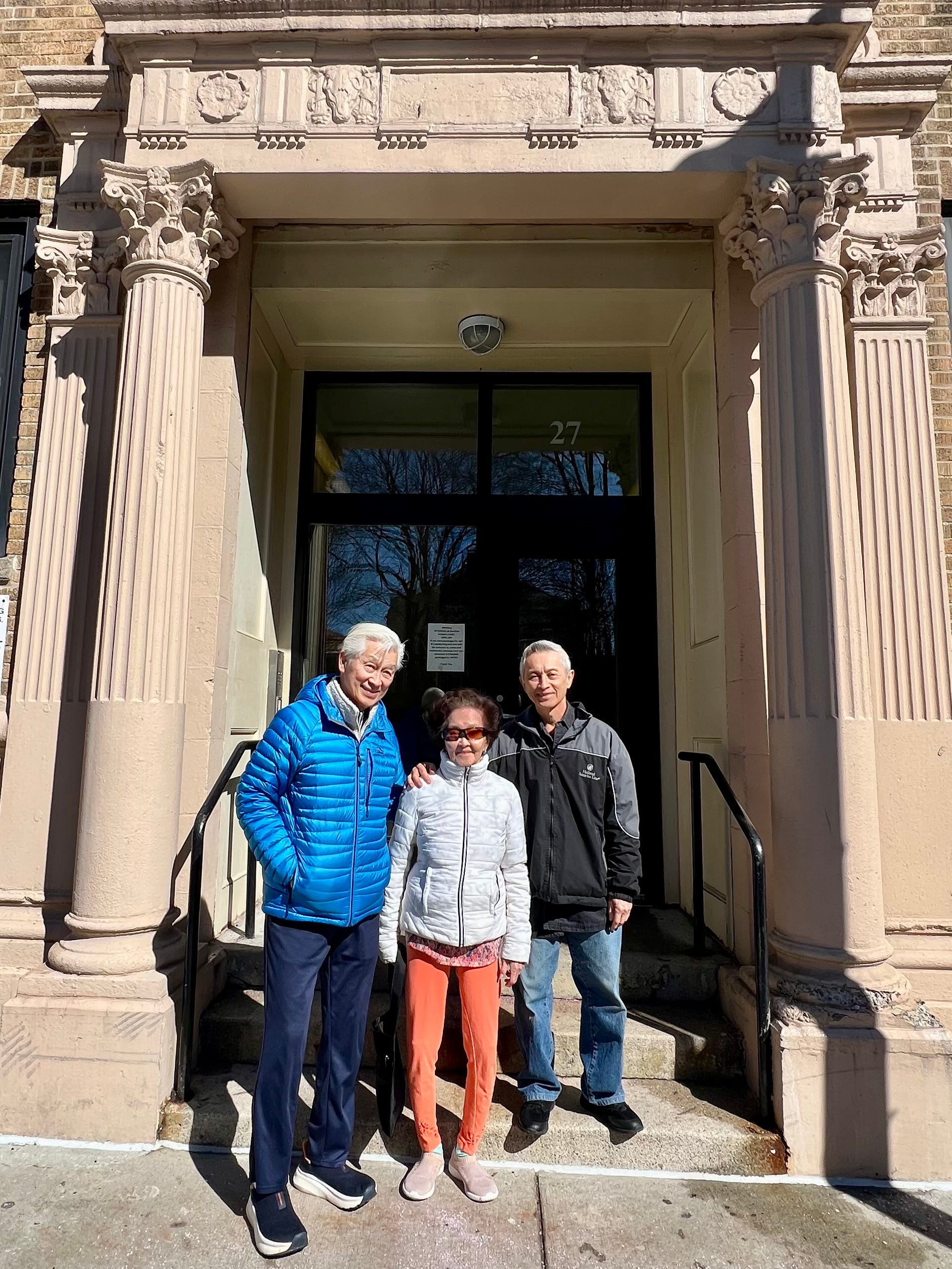
A few weeks ago, we celebrated my mother’s life in a small circle of family and friends in New Jersey. Afterwards, some of us drove up to Massachusetts to visit my 99-year-old paternal grandmother, the mother we still have.
We sat in the living room of her cottage, where she still lives alone, clinging fiercely to her independence and only lightly to the walls as she ambles, otherwise unaided, between rooms. When I tried to help her put on her jacket, she waved me away. No, no, I’ll have to do everything by myself again after you leave, she said. She took my arm to walk from the front door to the car, but let go after a few steps.
My father wanted to revisit the first stations of his American journey that had begun with his mother’s arrival in Boston from Singapore in 1956 with only her youngest son, my uncle Alan. A year later, my father and his older brother followed. Two boys, 11 and 12 years old, traveled alone on an ocean liner from Singapore to San Francisco, then by bus and plane to Boston.
Both homes were still there: there was the apartment building in Roxbury near the corner where my father was stabbed for not handing over 25 cents. After that came the single-family house in Mattapan. Walking down the sidewalk in Mattapan, my grandmother stumbled over a protruding drain cap. My husband reached out to steady her, but she caught herself with the practiced balance of the dancer she had been for decades until the pandemic struck.
She still remembered the exact street addresses of each house. She recalled certain neighbors, a neighbor with a dog who used to eat her flowers, another one who seemed envious of her. She recalled standing at the kitchen sink, drinking a glass of milk, when it shattered in her hand along with the pane of glass in front of her face, cracks radiating away from a clean bullet hole.
My grandmother posed for photos with her two sons in front of these buildings, stretching her back to her proud height of five feet two inches, still carrying so many stories within her tiny frame. I watched her take careful, graceful steps in her slip-on sneakers, hair perfectly coiffed—her non-negotiable prerequisite for leaving the house—and felt awe-struck by the force of life running through her. The matriarch of our family, my only remaining female elder. This woman who lost so much, who endured so much, who built her life all over again out of the ashes at least four times over a century of change.
I am about to resurrect a creative journey from the ashes myself, one I began in 2008.
Back then, I had just published a work of non-fiction and I had the hubristic idea that I could write a novel based on my grandmother’s life. I plundered my savings to travel to Singapore with my grandmother and retrace her roots. For a manic 72 hours, the longest stay I could afford, I researched in the library and scoured history museums, trying to unearth the culture that lay buried under the skyscrapers and light rail system of modern Singapore. I brought back history books, picture books, and photos of the house where my grandmother was born.
Because I had never written a novel before, I had no evidence that I would succeed, but I also had no evidence that I would fail. I wrote with abandon.
Two years later, I submitted a novel to my agent—yes, I had a literary agent back then in the 2010s, how luxurious! She submitted it in turn to the chief editor of a very famous publishing house, who replied with an encouraging yet devastating email that included the following lines:
This is a polished and gripping novel with many memorable scenes…Cheah’s prose is strong and elegant, but unfortunately I don’t think it is quite special enough to find a place on our very full fiction list at ______.
I had no idea how to proceed with the manuscript at that point. I had not expected success, and yet this rather flattering rejection proved that I had been far closer to it than I had imagined. My agent generously hired a professional editor, who suggested many ways of changing it into an entirely different novel. I read her notes and wept for my book. What she proposed might have become a commercial success, but it was not my book. Having no idea what else to do, I put it back into its digital drawer, where it stayed for over a decade.
Fast-forward to 2026:
I can’t sleep and a thought drops into my head, the kind of thought that makes other thoughts go quiet. It speaks in its own voice, not in mine:
Very few people get through childhood remembering how to love. Not love in the sense of desire, as in Spanish, but in the sense of acceptance, compassion—unconditional love.
Huh, I reply, and toss and turn along with that thought.
The voice patters on about Elizabeth Strout’s novels about Lucy Barton, that endearing, vulnerable character who has conversations in her mind, not with her real mother, but with the kind mother in her head she has invented.
Then the voice mentions Byron Katie’s ‘lady’ from A Thousand Names for Joy who shows up as a hallucinated companion after Katie’s enlightenment experience, a sweet, elderly lady who sits in the corner looking sad when Katie has betrayed herself in some way.
Don’t forget about Martha Beck, says the voice. In The Way of Integrity, she finds comfort in a Disney song (“Trust in Me” from The Jungle Book) at one of the lowest points of her life, understanding it to be divine intervention.
Hm, true, I start to muse, giving up on sleep. Isn’t it interesting how these externalized sources of love appear in some of the most influential books of my life?
Yes, continues the voice, books, exactly! Books are the medium for exploring complex ideas, like how to love unconditionally as an adult.
This thought feels like something my novel might say. As if this voice were my novel murmuring from inside its digital prison, ingratiating itself back into my life. Okay, I get it, I say. Would you please bring these thoughts to me during office hours next time?
Only if you listen, it says. I’ve been trying and you keep brushing me away to do unimportant things like taxes.
Point taken, I say.
Looking back, I see that the key word in that email, the one that paralyzed me more than anything else, was ‘special.’ For someone raised in the elite world of classical music, the word ‘special’ was charged. In that world, some children seemed to have been born with the innate ability to play like grown-up artists. There was nothing a non-special person could do to attain the same status, try as one might. There were other, more objective parameters that could be improved upon—intonation, sound quality, rhythm—but there was no guidance toward becoming special.
That word must have crept under my skin, thrown me off kilter, and sent me right back to the helpless childhood days of wishing myself into someone else’s shoes, someone born with more brilliance, talent, specialness. The editor might as well have told me my manuscript had been rejected because I didn’t have blue eyes; that’s how much agency I felt I had in the matter.
My grandmother lost her mother when she was three years old. She lost her grandfather and the home where she grew up at 14, when the Japanese invaded Singapore. She spent the next two years separated from her remaining family in a convent with the other orphans, where she learned to walk like a lady, balancing books on her head, and set the table for society dinners with the silverware in all the right places. She was 17 when the war ended; she left the convent, got a secretarial job in the municipality, and married a handsome businessman with whom she had three sons within four years. Five years later, he died in a plane crash, leaving her a young widow with nearly no education, no inheritance, and three children to feed. She mustered all her courage and intellectual resources and found a way to bring them all to the United States, where they could get the education her late husband had dreamt they would have.
She survived all that and much, much more.
Meanwhile, I had been stopped in my tracks by an adjective.
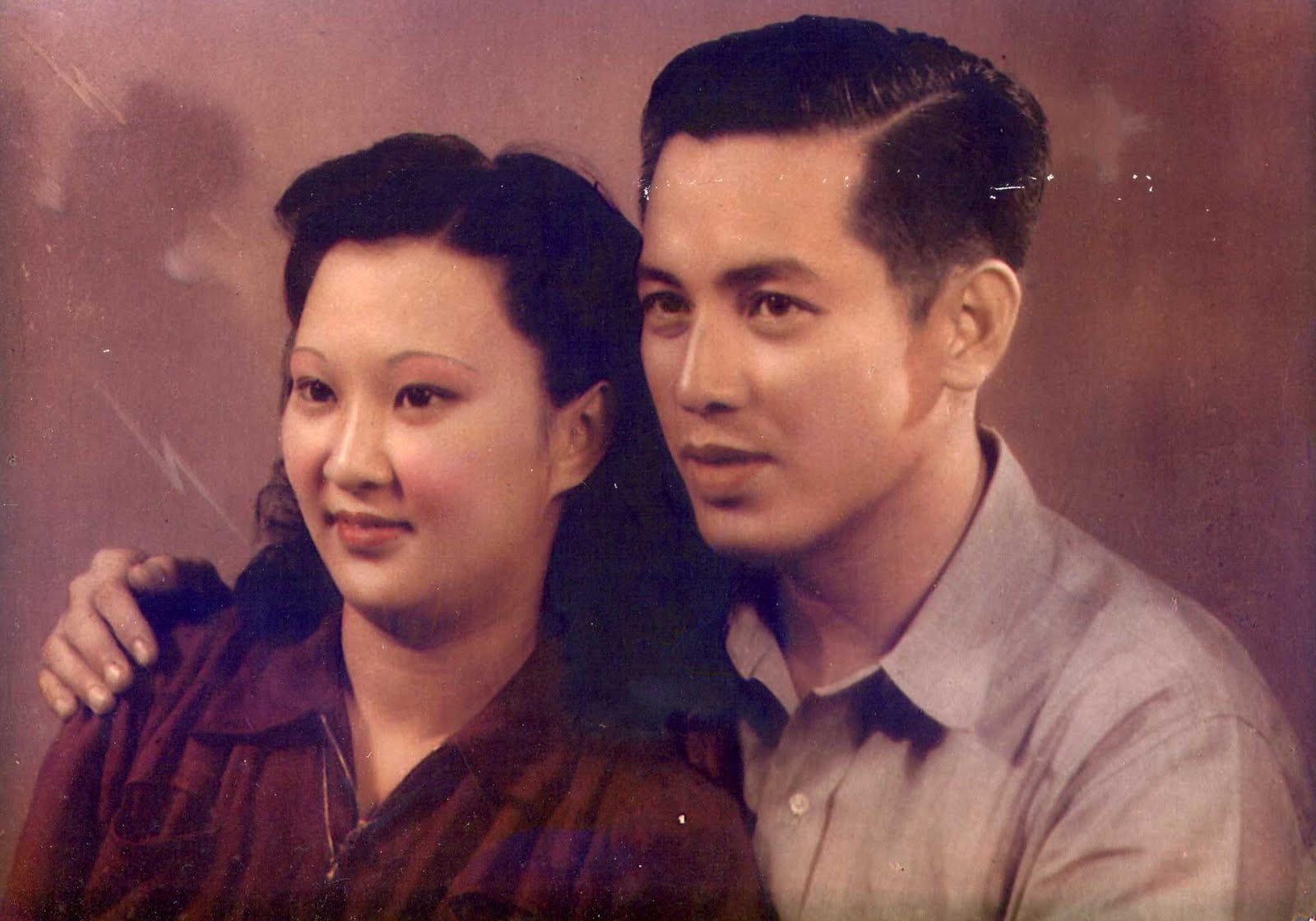
This was the reason I had undertaken this project in the first place: to write my way into embodying her energy.
I didn’t know her well as a child; she wasn’t anyone’s idea of a typical grandmother. She sometimes swept in with her glamorous hair, copious gold jewelry, and stylish clothes, bearing gifts from her world travels, and was gone again just as quickly: off to work, off to dance, off to travel. She was a busy woman. I saw her only a handful of times throughout my whole childhood, often for special occasions. She had no discernible need of grandchildren; she neither condescended to us, nor was she particularly interested in what we were up to. She had her own life and she was living it excellently.
She possessed an ineffable quality that I knew I lacked and that I struggled to identify.
Strength, yes. Resolve, yes. Fury, sometimes. But there was something else.
When I was a young adult living in Berlin, I started to call her long distance and ask her questions. I wanted to know about her life, but more than just the events, I wanted to understand what miracle made her able to go on traveling with friends after tragedy. What allowed her to dance when her heart had been broken multiple times. What kept her doing her hair and putting on her jewelry to face the world that had shattered for her like the glass of milk in her hand, like the window pane that was supposed to protect her.
My curiosity was more than a matter of family legacy; I needed this information urgently to inject it into my life like a serum.
It makes sense that the book is starting to talk to me now, 18 years later, in the wake of many losses in my own life. My grandmother had endured more heartbreak and rupture in the first 14 years of her life than I have in my nearly 50 years, and I turn to her now not necessarily as a role model, but as the genetic and cultural treasure trove that must somewhere be encapsulated in myself as well. The urgency of writing my own guidebook to resilience has returned.
Two weeks ago, I wrote about how a flight into literary fantasy landed me my real-life husband. I allowed myself to daydream and it brought up a truth I hadn’t been able to see through a rational lens.
Now, as I shoulder the full weight of many forms of grief—personal, professional, communal—I long to discover that I, too, possess the life force—the chi—that my grandmother still channels every day.
There is so much I am trying to process right now, not just the losses of everything from my cat to my professional identity to my mom, but also the understanding that my path forward may have very little to do with the one I have walked thus far. We extrapolate the future from the past, and yet life is now asking not just me but all of humanity to radically change course. To reimagine our way forward, we must abandon fossil fuels, war, othering, factory farming, single-use plastics, human trafficking, authoritarian governments, the exploitation of vulnerable populations and ecosystems.
It seems like a hell of a time to hunker down and make up stories. Counterintuitive is not a strong enough word.
My conditioning—the old path—would have me scrambling 24/7 to replace the income I am losing from my university salary. It would have me expending energy I don’t have volunteering for charitable organizations. Instead, I’m taking deep breaths, walks in the mountains, having conversations with a dormant book, and letting my coaching reputation spread by word of mouth. I’m meditating and sending prayers to war zones and climate-ravaged ecosystems.
It’s not a logical solution. But in my heart, not my head, is the tremulous notion that if I can crack the code, if I can extract the power from the seed of this book, then I will be living the love that renders words like ‘special’ meaningless. I will be creating the lifeline of joy in the midst of despair that so many people need so desperately right now.
I’ll let you know how it goes.
Simply beautiful! And I understand how the word “special” can stop you in your tracks. For me, it’s the tension between yearning to be special and being so afraid of what would happen if I was. Still trying to figure out how to crack the code on that one.
Looking forward to seeing how this seed grows!!
So deeply touching, thank you for Sharing Elena